
INTRODUCTION
The Biblical Requirement for the Mikvah
The foundational obligation for ritual immersion is derived from the verse[i], ורחץ במים את כל בשרו – and he shall bathe his whole body in water. Rashi, commenting on the words “his whole body,” explains that immersion must take place in a body of water sufficient to encompass a person’s entire body simultaneously. The Sages[ii] quantified this volume as forty (40) סאה. The Shulĉan Aruĉ[iii] codifies this as the absolute baseline: any gathered[1] body of water lacking this minimum volume of forty (40) סאה is invalid for purification.
The Six Levels of the Mikvah
The Mishna[iv] delineates six (6) progressive tiers of natural water bodies used for purification, ranging from puddles of rainwater to living springs.
- Immersion for a Niddah: The Sifra[v] deduces from the text that a menstruant woman may immerse in a standard gathered Mikvah. The Rambam[vi] and the Shulĉan Aruĉ[vii] codify that a Mikvah of standing rainwater, containing forty (40) סאה, is fully sufficient for her purification.
- Immersion of Utensils: Utensils purchased from a non-Jew also require immersion in a standard Mikvah.[viii]
- The Tum’ah of a Zav: It is critical to note that a Zav requires a living spring[ix] and would not be purified through a standard Mikvah. However, during our current exile, the laws governing the severe impurity of the Zav are no longer practically maintained, shifting the architectural focus entirely toward standard Mikva’s.
Natural Water vs. Drawn Water (מים שאובים)
Defining Natural Water
Today, most Mikva’s are engineered to gather rainwater rather than utilizing flowing subterranean springs.
- Stationary vs Flowing: Naturally gathered water (a מקוה) is only Kosher באשבורן – meaning it must remain stationary and contained. Spring water, conversely, is Kosher בזוחלין – meaning it purifies while flowing.[x]
- Converting a Spring: A spring can be converted into the Halaĉic equivalent of a standard Mikvah by pooling the forty (40) סאה into a stationary basin; once contained, it loses its flowing status and cannot purify while flowing.
- The Overflowing River: The Shulĉan Aruĉ[xi] illustrates this with the example of an overflowing river; if an inlet is established where the water is gathered and does not flow much, it qualifies for immersion.
- מים מוכים: Discolored or dense natural water remains acceptable as long as it does not violate two parameters:
- שינוי מראה – it does not undergo an unnatural change in appearance, and
- שם מים – it retains the classification of water.
Change in Appearance: Refractive Index and Snell’s Law: Changing the density of water changes how light travels through it. This is calculated using a Refractive Index formula

The bending of light can be calculated by Snell’s Law:

While differences in refractive properties indicate altered density, they do not inherently mean the fluid is no longer water. Shulĉan Aruĉ[xii] disqualifies water based on a change in pigmentation (dye, blood), not a change in refractive density.
Etymological שם מים: In determining whether the water retains the “classification” of water, it is worth noting that the term מים can denote both a general liquid[2] or specifically

– water. Halaĉically, the molecular bonding of natural elements (like NaCl) to the water does not remove its classification as water.
- Algal Bloom (Eutrophication) in a Rainwater Pool vs. Mineral Rich Springwater: The Mishna confers a status of מים מוכים to a spring which has been discolored or smells off due to minerals, which can continue to be used for immersion in that state. For example, hot springs are often sulfuric, which produces a rotten smell stench, and has a cloudy appearance – and yet such springs can be immersed in. However, standing rainwater though does not remain kosher when overcome with algae. When a rainwater Mikvah develops heavy algae from bacteria, it must be emptied, cleaned, and renewed.
- Algae as an Obstruction: Overgrowth of algae, which is a material foreign to the water, could theoretically become an obstruction to immersion. However, the Shulĉan Aruĉ[xiii] rules that natural sand / mud (minerals) does not constitute an obstruction because it naturally preceded the water.
- vs Dirty Water: The Gemara[xiv] notes that ancient Mikvah water was often visibly dirty, prompting people to shower afterward. The sages did not have a problem with the Mikvah being in that state. Rather they were concerned that people might decide to shower rather than immerse if the Mikva was too dirty.
Conclusion: Unnatural Additives: Additives that fundamentally change the chemical pigment (like wine or dye) render the water unnatural and therefore not Kosher for immersion. Acceptable Additives: Natural earth, salt, or snow are explicitly acceptable.
Defining Drawn Water (מים שאובים)
Drawn water is defined as water which has been gathered through non-natural means. There is an argument amongst codifiers if Drawn Water is Biblically prohibited or is a Rabbinic ordinance. For the purposes of this paper, we will assume that is presence is Biblically prohibited. The minimum measurement of Drawn Water that when added can invalidate a Mikva is the volume of three (3) Log.[xv]
To be Halaĉically classified as “Drawn Water”, the following criteria related to the vessel must be met:[xvi]
- The vessel is a utensil, receptacle and / or other similar items[3].
- The object used to move the water has to be capable of holding the water in place; not absorbent or soluble, and enclosed on all sides or the water will flow outward.
- It must be designed[4] for the purpose of containment[xvii].
- It must be self-supportive. A container that only remains contained so long as it is manually held in place is not a container.
- It must be detached from the ground.
Furthermore, the addition of Drawn Water into a Mikvah must be intentional[xviii].[5] And finally, the Drawn Water must be added before the gathering of natural water reaches the volume of forty (40) סאה.
Dilution Post-Establishment: Once forty (40) סאה of natural rainwater is established, adding drawn water does not dilute or invalidate the Kosher status of the original volume[6].
- השקה – kissing, זריעה – planting, and Pascal’s Law: Halaĉa defines[xix] the moment of contact, known as השקה – a kiss – between Kosher Mikva water and Drawn Water as sufficient to render the entirety of the Drawn Water as Kosher for immersion. This does not translate back through the piping system throughout the entire city, etc. Since, as we noted previously, a Mikva made by gathered rainwater is only Kosher באשבורן – in their stable location. Moving rainwater (and the water in the pipes of tap water are moving from one location to another[7]) is not Kosher while flowing, even if the moving water was completely rainwater.[8]
The concept by which Drawn Water that kisses a body of Kosher Rainwater is rendered thereby Kosher for immersion can be linked to the physical properties of water [or any liquid] – namely that pressure exerted at an point in a closed system containing a contiguous amount of liquid will be applied equally throughout the liquid. Mathematically, this is described in Pascal’s Law:

This practically instantaneous transference of pressure[9] by the liquid of the Drawn Water kissing the pooled Kosher Rainwater, is felt throughout the entirety of the cistern in which the Kosher Rainwater sits.
- The process of זריעה – planting is somewhat different than kissing but accomplishes the same goal. Drawn Water can be “planted” within the water of a Kosher Mikvah – passed through – which would [somewhat – see Ra’avad’s exception] remove the status of Drawn Water from it. This Planted Water is then allowed to overflow from the cistern in which Kosher Mikvah water sits into an immersion pool.
Conclusion: Fluidic Continuity: To successfully use the process of השקה there need not be a mixing of the various waters. Mere fluidic continuity across a boundary between multiple pools triggers this effect.
- Pumps and Flow: Moving Mikvah water through mechanical pumps does not disqualify rainwater under the rules of זוחלין – flowing, but it does render it Drawn Water by virtue of having deliberately passed through a vessel. However, that water pumped back into the pool becomes requalified upon contact with the Mikvah again.
The Ra’avad’s Ruling נטל סאה ונתן סאה
There is a critical exception to the process of השקה and זריעה: A Mikvah retains its purifying power only so long as the original forty (40) סאה remains in place.[xx] However, if the Drawn Water flushes in and replaces the original rainwater volume, it can no longer render other waters Kosher.[xxi]
CURRENT MIKVAH CONSTRUCTION DESIGNS
Historical Aside
Due to the difficulty in gathering water, and, as noted by the Gemara above, that a preference for cleanliness exists so that people will not want to shower after immersing in the Mikvah, Mikva’os were generally dug to tap into spring water. This had the benefit of providing a natural filtration system, cleaning out the old water and replacing it with new water.
However, during the times of the Alter Rebbe, when many Jews lived in countries with extreme cold temperatures, using a Mikva made of natural spring water in the winter was not a practical possibility – especially since the extreme cold would be very unhealthy for women immersing there.
Accordingly, the Alter Rebbe issued a ruling[xxii] which revolutionized Mikva construction. He designed a Mikva were the immersion pool would be contained in a wooden box that is not fully sealed and would be lowered so that the bottom half of the box would fill with the spring / subterranean water. Since the box was not fully sealed, the natural water would freely move in and out of the immersion pool, and since the immersion pool was in a box, scalding water could be heated in pots and poured into the freezing cold spring / subterranean water [which had a minimum of forty (40) סאה constantly present]. The water would not remain permanently hot, but for a while it would be at a safe temperature for women to immerse in.
When municipal tap water started becoming prevalent, and when the Jews of Russia began leaving the small villages where springs were plentiful, and migrating into cities, there was a need to revisit Mikva design. Two basic designs were proposed:
The Ĉasam Sofer: Side-by-Side
To create an immersion pool which could be heated and used without constantly seeking out and or waiting for rainwater to fall, the Ĉasam Sofer[xxiii], based on the Halaĉic case listed in the Shulĉan Aruĉ[xxiv], issued guidance to design a Mikva with two areas in which water would be gathered.
- The Rainwater Cistern – in one container, built into or otherwise attached to the ground, rainwater in a minimum amount of forty (40) סאה would be allowed to gather. This Rainwater Cistern would not be used by people to immerse.
- The Immersion Pool – immediately adjacent to and sharing a wall with would be the immersion pool. This pool could be filled with regular heated tap water. The Drawn Water in the immersion pool would then be rendered Kosher to immerse in by having a sufficiently large[10] hole drilled in between the two sections letting the tap water ‘kiss’ the rainwater.
This design ensures any amount of tap water can be added to the immersion pool, allowing for the construction of relatively large and comfortable Mikva’os. Furthermore, by ensuring that the pools remain relatively isolated, the concern of violating the Ra’avad’s exception to the ability of rainwater to render Drawn Water acceptable is avoided – since the aperture is very small, there is little concern of the original rainwater being lost to the immersion pool. Furthermore, one could clean out the immersion pool by inserting a stopper[11] into the aperture while the immersion pool is being cleaned, and then the immersion pool can be refilled once again with tap water (Drawn Water).
The Rashab: Stacked (בור על גבי בור)
The Rashab determined to use a similar concept of the two segregated pools, but he innovated that these pools must be stacked one on top of the other.
The Baffle
The kinetic force of immersing in the immersion pool causes the water to experience differences in pressure. Since the Rainwater Cistern is stable, while the immersion pool is moving, the pressure differential will cause the rainwater to flow out of the cistern in the immersion pool. And while that is perfectly fine when there is forty (40) סאה of rainwater, it becomes exactly the problem of נטל סאה ונתן סאה over time as the tap water gradually flows back into the cistern replacing the rainwater and placing the cistern in a status of being unable to render Drawn Water valid for immersion.
By placing a floor separating the pools to act as a baffle, shielding the rainwater from the kinetic turbulence of immersion, this would limit the loss of the rainwater into the immersion pool.
The Thermocline
Furthermore, since the rainwater cistern is below the immersion pool, and the immersion pool is heated, that creates a temperature differential, a thermocline.[12] A thermocline operates because the density of water changes with temperature, creating a stable, layered system where thermal energy transfer becomes restricted primarily to slow molecular diffusion. The density of a given body of water relative to its temperature is stated as:

where:
- ρ₀: Reference water density (1000 kg/m³).
- α: Thermal expansion coefficient of water (≈ 2.1 × 10⁻⁴ K⁻¹ at 20°C).
Because α > 0, an increase in temperature T results in a decrease in density ρ. Warm water sits on top of cold water, creating a stratified layer. Since a thermocline operates where the denser (colder rainwater) sits on the bottom of the baffle, while the less dense warm Drawn Water sits on top of the baffle, this effect serves to keep the colder rainwater in the lower cistern, minimizing the kinetic energy of the immersion. This effect is not present when the two sections sit side by side, as in that scenario, the water from the colder cistern will constantly “leak” into the warmer immersion pool because the colder water is denser.
To determine if this thermal layer will persist or mix, fluid dynamics uses the Brunt-Väisälä frequency (or buoyancy frequency), denoted as N. It represents the frequency at which a parcel of water will vertically oscillate if vertically displaced:
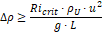
where:
- g: Acceleration due to gravity (9.81 m/s²).
- z: Vertical depth coordinate (defined here as pointing downward, so z increases with depth).
Substituting the thermal equation of state into the buoyancy frequency equation yields:
In a typical water body heated from above, temperature decreases as depth increases, meaning

. This makes N² > 0, resulting in a real frequency N. A positive N² indicates a statically stable system. The thermocline layer represents the maximum value of N², meaning it is the most stable zone in the water column and resists vertical mixing.
However, we are not talking here about stable bodies of water with invariant temperatures. The upper immersion pool is subjected to active heating elements, whether through the addition of heated materials or the introduction of pumped-in hot water. As a result, over time, one would expect that the heat from the immersion pool would seep into the lower rainwater cistern. Furthermore, the upper immersion pool is subjected to frequent use, and the kinetic energy involved in immersion creates eddies and changes in pressure, which due to Pascal’s Law, are felt throughout the entirety of the fluidly connected bodies of water. This is expected. And while there is some mixing of the water, inside the thermocline the high stability (N²) suppresses turbulence. Fluid mechanics models this suppression by scaling Kz inversely with stability using the Richardson number (Ri):
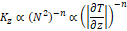
Because Kz drops exponentially inside the thermocline toward the molecular diffusivity of heat (≈ 1.4 × 10⁻⁷ m²/s), the thermocline acts as a highly effective thermal insulator that traps heat above it.
Furthermore, the transference points were limited by the Rashab to two (2)[13] Tefaĉ2 apertures[xxv], so the baffle not only serves to prevent the transference of the kinetic energy generated by the immersion but also serves as an insulator to maintain the temperature differential producing the thermocline effect.
PROPOSAL – THE ADDITION OF THE HALOCLINE
To improve upon and continue in the tradition of the Alter Rebbe’s suggestion with the Rashab’s implementations, the addition of a halocline—coupled with the existing innovations of the baffle and the thermocline—would serve to further inhibit the loss of rainwater.
A “Halocline” is a distinct later in a body of water, where the salinity density changes rapidly with depth. Because freshwater is lighter and less dense than saltwater, when the two liquids are together, they resist mixing creating a distinct, stratified boundary layer between them – similar to the effect produced by a thermocline.
To determine the amount of salt required to make the halocline impenetrable to the kinetic energy of the immersion, we must calculate the point at which the stabilizing force of buoyancy overcomes the destabilizing force of kinetic shear.
Mathematics of Determining the needed Halocline
Determining the Stability Threshold
In fluid dynamics, the stability of a stratified fluid is determined by the dimensionless Bulk Richardson Number. For the halocline to remain stable and resist kinetic mixing, the Richardson number must be greater than or equal to a critical threshold

. For absolute stability against aggressive turbulent displacement, engineers typically target an

of 1.0 or higher.
The formula is expressed as:
Where:

Acceleration due to gravity


The density difference between the heavy lower water and light upper water


The characteristic length scale of the turbulent eddy (in this architecture, the diameter/width of the tefach hole, approximately


The density of the hot upper tap water.

The characteristic velocity of the water displaced by the immersing person

By rearranging the equation, we can solve for the minimum required density difference

to prevent mixing:
The Linear Equation of State for Density
Once we know how much denser the lower cisternmust be, we calculate the salinity required to achieve that density. The density of the lower cisternis determined by a competition between temperature and salinity, expressed by the linear equation of state:

Where:

Reference density of pure water.

Haline contraction coefficient (how much salt increases density, roughly


Salinity concentration in parts per thousand (ppt).

Thermal expansion coefficient (how much heat decreases density).

AND

Temperatures of the lower and upper cistern.
The Final Salinity Equation
By substituting the density requirement into the equation of state and isolating Salinity (), we arrive at the master formula for the required salt concentration (in ppt):
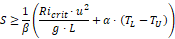
Note: Because (rainwater) is colder than
(hot tap water), the term

is negative. This mathematically proves that the cold temperature of the lower cistern reduces the total amount of salt needed.
Calculating Total Salt Mass ()
Once you have solved for S (the required concentration in grams of salt per liter of water), you can calculate the exact weight of salt required for the mikvah by multiplying it by the total volume of the lower cistern:

Where

is the total mass of salt (in kilograms) and

is the total volume of the lower rainwater cistern(in liters).
Halaĉic Review of the Halocline Proposal
Salt Does Not Diminish Halaĉic Status of the Rainwater
- The Shulĉan Aruĉ explicitly states[xxvi] that salt can be added to a Mikvah without invalidating it.[xxvii]
- The presence of concentrated salt does not violate שינוי מראה. The salt in the Mikvah dissolves colorlessly. It has no pigmentation to render the water changed in appearance. And, as we discussed above, the difference in refraction is not related to the substance of the water, but to its density. The same relative change in refraction due to salty water can be achieved by cold water.
- Nor does the water change the שם מים. The Gemara[xxviii] explicitly validates immersion in the Dead Sea, whose waters contain the highest concentrations of salt.
Overcoming the Engineering Challenges of a Salted Cistern
The Problem of Increased Density: The presence of salt makes the water denser, meaning the same mass takes up less space. Since a Kosher Mikvah requires forty (40) סאה strictly by volume, the total collected rainwater must be increased.
- Density Math:
Pure water has a density

of 1.00 kilograms per liter requiring 726 kg of water for forty (40) סאה. At our target halocline salinity of seventy (70) grams per liter density increases to 1.05 kilograms per liter. The foundational mass of pure rainwater must remain the anchor, necessitating a larger cistern to ensure the forty (40) סאה minimum is never compromised by density variances.
The Problem of Volumetric Expansion: Although salt does not Halaĉically detract from the volume of water, it also cannot be used to add to the volume by physically dissolving massive amounts of salt into a deficient amount of rainwater, since salt expands the spatial volume (partial molar volume). To resolve this, this process of salting the rainwater can only be implemented when the cistern is greater than forty (40) סאה.
- Expansion Math:
Our specified cistern capacity is double (eighty (80) סאה / at minimum 1,452 L). To achieve seventy (70) grams per liter salinity across this volume requires about 101.6 kilograms of salt. Solid salt

displaces volume at

If the cistern were exactly 726 liters, those 47 liters would overflow and destroy the Kosher status, as the remaining water in the cistern would not be eighty (80) סאה of water. Utilizing the 1,499 liter cistern allows the total volume 1,452 + 47 = 1,499 to sit safely within the oversized cistern.
Molecular Diffusion and Maintenance: All things being equal saltwater in contact with freshwater will gradually lose some salinity over time to the immersion pool.
- Fick’s Law & Stokes-Einstein: Passive migration can be measured by Fick’s First Law:

However, the Alter Rebbe’s heated pool fundamentally alters the diffusion coefficient (), modeled by the Stokes-Einstein Equation:

Where:

Boltzmann constant


Absolute temperature of the water in Kelvin.

Dynamic viscosity of the fluid.

Radius of the solute molecules (NaCl ions).
As upper temperature () increases, dynamic viscosity (
) decreases. This indicates that molecular diffusion will happen faster in a heated cistern than a cold one, but diffusion will still occur in a cold cistern – necessitating a structured maintenance protocol.
- Maintenance Decay Math:
The daily decay rate for our 1,499 L cistern is approximately 0.334%

Using the exponential decay formula

the half-life () is just over 200 days. Thus, the maintenance plan requires adding salt tablets only twice a year to preserve the system.
MEASUREMENTS
In producing the above math, the following Halaĉic measurements and volumetric conversions were adopted:
- Tefaĉ = 8.833 centimeters
- Log = 0.336 liters
- שפופרת הנוד – neck of a waterskin = a circle 48 millimeters in diameter
- סאה = 18.15 liters
- בור Cistern Capacity is double forty (40) סאה. Thus, the cistern is assumed to have a minimum of 1452 liters / 80 סאה.
[1] Excluding a natural spring which is not subject to the minimum size requirement.
[2] As in the seven (7) liquids which, when falling on fruit, renders the food susceptible to Tum’ah. The verse which provides the source for this Halaĉa is [Vayikra 11:38 ] וכי יתן מים which uses the term מים, even though the liquids of י”ד שח”ט ד”ם (wine, blood, oil, milk, dew, honey, and water) are intended.
[3] Technically, the immersion pool or the cistern might also be considered an oversized utensil, which is why holes are punched through it, and it is connected directly to the ground, rendering it an extension of the ground.
[4] This specifically excludes a deformity in a pipe for example in which after time part of the pipe begins to deform with a bulge in which water that is passing can collect.
[5] For example; the Shulĉan Aruĉ discusses cases where a person didn’t add the minimum requirement for invalidation, and then someone else accidentally adds more Drawn Water rendering the total addition sufficient to invalidate. Or where the water is being added intermittently eventually reaching the total amount to invalidate.
[6] As the Ra’avad explains, the ability for a Mikva to render Drawn Water permissible for immersion is only so long as the original volume remains in place – as we will discuss momentarily.
[7] There is a discussion in the Shulĉan Aruĉ concerning water which leaves and returns to the Mikva – whether that is considered זוחלין – flowing – as in the case of a person immersing vigorously in which the water sloshes over the sides of the Mikva but is still contained within the overall Mikva container. The consensus is, based on the Mishna’s case of a needle placed on a step leading into a water filled cave in which waves were generated to a height sufficient to exit the pool and splash over the needle – the needle is thereby rendered Tahor, even though the water was moving at the time of immersion, in the form of a wave, outside the pool in which the water had been contained.
This concept could theoretically be applied to a closed pumping system, in which the movement of the water through the pipes does not render the water זוחלין since the water is designed to return back to the pool. Additionally, one could put forth a theoretical argument that since the intention of the pump system is not to contain the water, but to instead pass the water through a filter, or to heat it… and since the pump is a fixed element attached to the Mikva, which is attached to the ground… perhaps the water that passes through is not considered Drawn Water by virtue of having been pumped.
However, the Halaĉic reality of the heating system is a discussion beyond the scope of this paper – and certain these theoretical musings should not be considered practical considerations in determining the Halaĉic status of water passing through pipes.
[8] Which is why one cannot stand outside in the rain and consider that an immersion.
[9] Perhaps this ability for the application of pressure to render water Kosher can be derived from its opposite – that a Nida has the unique ability to render something טמא through the application of pressure, even without being in direct contact or in the same airspace as the item. This idea though is beyond the scope of this work.
[10] The minimum Halaĉic size for this opening is כשפורפרת הנוד – the tube (neck) of a waterskin, which converts to a circle about forty-eight (48) millimeters in diameter.
[11] Of Kosher material and design.
[12] I do not know if the Rashab stated this explicitly as one of his reason’s, but the effect is there and worth exploring.
[13] So that if one should be clogged up or covered, the other would still serve to act as a point of השקה.
[i] Vayikra 15:16
[ii] Gem. Eiruvin 4b – See Yoreh Day’uh 201:1
[iii] Yoreh Day’uh 201:
[iv] Mikva’os 1:1–8
[v] Sifra Metzora Parshas Zavim
[vi] הלכות מקואות 1:1-2
[vii] Yoreh Day’uh 201:1
[viii] See Rambam הלכות מקואות 9:1
[ix] Vayikra 15:13
[x] See Mishna Mikva’os 5:4
[xi] Yoreh Day’uh 201:2
[xii] Yoreh Day’uh 201:24. See also Mishna Mikva’os 7:3
[xiii] Yoreh Day’uh [Rama] 198:33
[xiv] Gem. Shabbos 14a
[xv] Mishna Mikva’os 3:1
[xvi] See Shulĉan Aruĉ Yoreh Day’uh 201:6 and Rambam הלכות מקואות 6:1-2
[xvii] Yoreh Day’ah 201:34, 36
[xviii] Mishna Mikva’os 4:1
[xix] Mishna Mikva’os 6:8
[xx] See Shulĉan Aruĉ Yoreh Day’uh [Rama] 201:24
[xxi] See the Ra’avad’s foundational work on Mikva’os, the בעלי נפש: שער המים
[xxii] See responsa of the Tzemach Tzedek Yoreh Day’uh 171
[xxiii] See responsa of the Ĉasam Sofer Yoreh Day’uh 203, 212 and 214
[xxiv] Yoreh Day’uh 201:54
[xxv] See also Ĉazon Ish, Yoreh Day’uh Mikva’os 123
[xxvi] Yoreh Day’uh 201:30
[xxvii] See Igros Moshe Yoreh Day’uh 1:110
[xxviii] Gem. Shabbos 109a
Bravo